
Blog Listening to the Moon: On Writing Poetry
By Srijani Mitra | Guest Blog
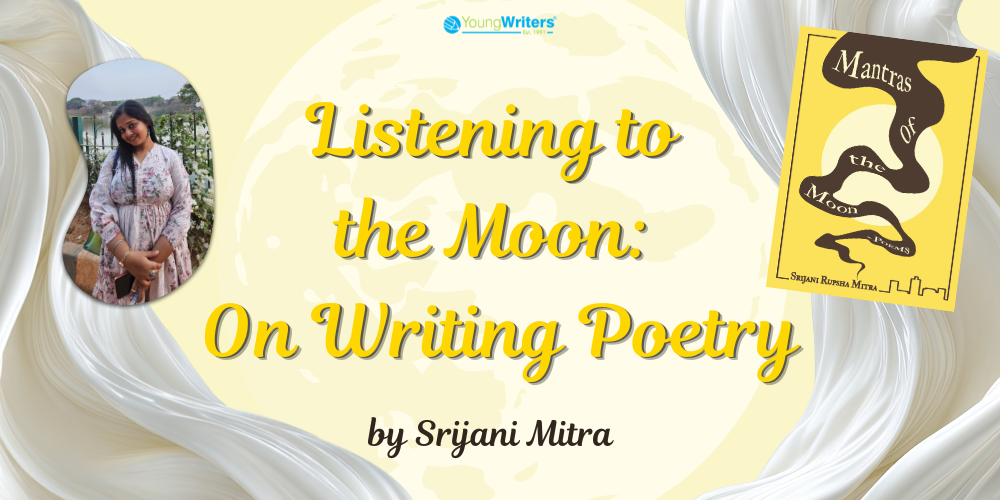
For a long time, I wondered why poets are
so often drawn to the moon. The image appears everywhere in poetry be it quiet
moons, restless moons, moons that witness human longing from afar. At first, it
seemed like a romantic habit poets had inherited from one another. But when I
began writing the poems that would eventually become Mantras for the Moon, I
started to understand that fascination in a very personal way. The moon moves
through phases like appearing, fading, returning again with quiet persistence.
Writing poetry began to feel similar. There were nights of clarity and
inspiration, and there were long stretches of confusion, abandoned drafts, and
uncertain beginnings. Yet slowly, like the moon emerging from shadow, the poems
began to find their shape.
Writing a poetry book can feel daunting.
There are many failed drafts, plenty of confusion, and moments when you wonder
whether the work will ever come together. But there is also excitement in the
process. Each poem feels like a discovery, and gradually those discoveries
begin to form a larger journey.
My own journey with poetry began when I was
a child. I first wrote in my mother tongue, without thinking about publication
or audience. Poetry at that stage felt instinctive, simply a way to express
emotions and thoughts that were difficult to explain otherwise. I wrote
quietly, mostly for myself.
For many years, however, I did not have the
courage to send my poems to publishers or magazines. Sharing poetry can feel
incredibly vulnerable. A poem often carries fragments of the writer’s inner
life, and the idea of placing those fragments in front of strangers can be
intimidating.
It was during the lockdown that this
changed. The stillness of that period forced many of us to slow down and
reflect on our lives. For me, it became a time to reconsider my relationship
with writing. I realised that if poetry mattered so much to me, I should not be
afraid to let it exist beyond the pages of my notebooks.
Around the same time, I had begun writing
more poetry in English. I was deeply inspired by poets such as Arundhati
Subramaniam, whose work blends spirituality, introspection, and contemporary
life in striking ways. Reading poets like her encouraged me to think about
poetry not just as personal expression but also as a dialogue with readers.
Eventually, I gathered the courage to start
submitting my poems to literary magazines. The first acceptance was
exhilarating. There is something magical about seeing your work appear in a
publication and realising that your words have travelled beyond your own
imagination to reach someone else.
Of course, the publishing journey was not
always smooth. Like most writers, I also encountered rejection. Some poems that
I had worked on intensely were declined. Rejection can feel discouraging,
especially when you have poured genuine emotion into your writing. But over time
I began to understand that rejection is simply part of the literary landscape.
A poem might not be the right fit for one magazine but could resonate perfectly
with another. Instead of giving up, I continued writing, revising, and submitting.
That persistence eventually led to a
publishing opportunity with Red Rook Press, an imprint of University of Alabama
Press. Before submitting my manuscript, I spent considerable time researching
poetry publishers and understanding the kind of work they published. The
aesthetic vision of Red Rook Press felt aligned with my own writing, so I
decided to send my manuscript there.
Then came the waiting period. Waiting can
be one of the hardest aspects of publishing. Months pass, and you continue
writing while quietly wondering whether your manuscript will find a home.
Nearly a year after submitting, I received the news that my manuscript had been
accepted. My book had been selected from around twenty-five poetry manuscripts
submitted from different parts of the world.
It was a deeply meaningful moment, not only
because the book was accepted, but also because it affirmed the importance of
patience and persistence in the creative process.
Mantras for the Moon is the culmination of
nearly five years of writing. Many of the poems in the collection were first
published in literary magazines before coming together in the form of a book.
As the manuscript slowly took shape, I realised that the poems were connected
by a recurring idea which is the lunar
cycle as a metaphor for human emotion.
Just as the moon waxes and wanes, our
emotional lives move through phases. Feelings expand, retreat, disappear, and
return again in altered forms. Some moments feel radiant and full, while others
feel shadowed and uncertain. The poems in the book attempt to explore these
shifting emotional landscapes.
Spirituality also plays an important role
in my writing. For me, spirituality is not something distant or abstract. It is
closely connected to culture and selfhood almost as the way traditions, stories, and beliefs shape
our inner lives.
In many ways, my poetry tries to discover the extraordinary within the ordinary. Everyday experiences such as a conversation, a memory, a quiet ritual often contain surprising depth when observed carefully. Poetry allows those moments to expand and reveal their hidden meanings.
I have also written poems that reflect on the act of writing itself. Poetry is not only about emotion but it is also a craft. Learning how to shape language, rhythm, and imagery is something I deeply enjoy. Writing about the process of writing becomes a way of acknowledging the discipline that poetry requires.
For young writers who are beginning their
own creative journeys, I would like to share a few thoughts.
First, do not be afraid to send your work
to publishers and literary magazines. It can feel intimidating at first, but
every submission is a step forward. Even when a piece is rejected, the act of
sharing your work is part of learning and growing as a writer.
Second, cultivate patience. Writing, especially
poetry, rarely brings immediate results. Poems take time to develop,
manuscripts take years to build, and publishing decisions often take months.
Patience allows you to continue writing without losing motivation.
Finally, practise your craft consistently.
Inspiration is important, but discipline is equally valuable. The more you
write, the more your voice will grow stronger and clearer.
When patience and practice come together,
something remarkable begins to happen. Your confidence grows, your ideas
deepen, and your writing begins to feel more authentic.
In many ways, writing poetry is like
listening to the moon. It requires quiet attention, curiosity, and trust in
slow cycles of growth. There will be moments of brightness and moments of
darkness. But if you continue listening and continue writing, the poems will
eventually find their way into the light.