
Blog The Right Word Changes Everything
Are you
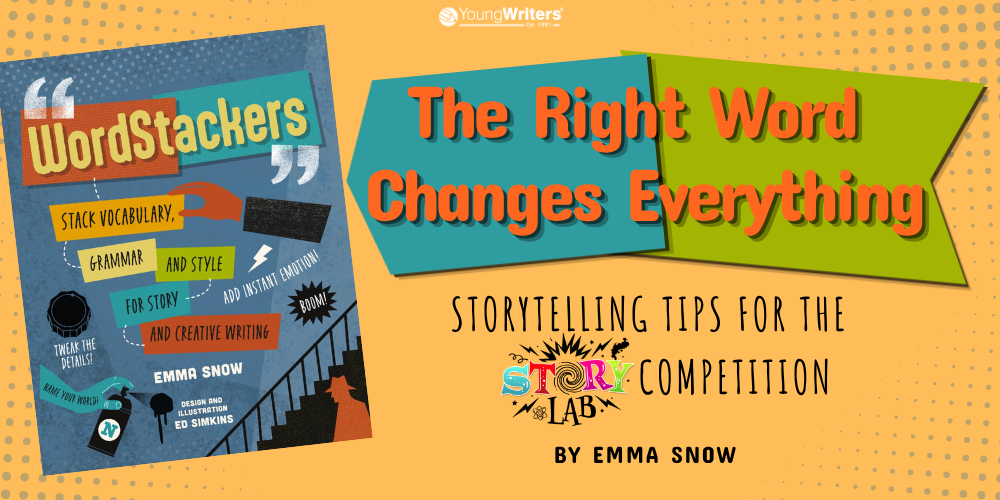
getting ready to enter the Story Lab competition this summer? If so, WordStackers
was made for exactly this kind of challenge.
In a
500-word story, every sentence matters. A single word choice can turn an
ordinary moment into something tense, vivid or unforgettable. That’s what WordStackers
is all about: helping young writers discover how carefully chosen words can
shape atmosphere, suspense, action and emotion.
Because
the most powerful stories are not always the ones with the biggest plots or the
fanciest vocabulary.
They are
the ones that make readers feel something.
And very
often, that feeling comes from small choices on the page: one sharp verb, one
loaded adjective, one powerful noun.
Packed
with WordStacks designed to power up your storytelling, WordStackers
explores how the right word really can change everything.

One of
my favourite parts of WordStackers is a collection of WordStacks called Mood
Buffs. Mood Buffs are words that quietly steer the atmosphere of a scene.
Instead of directly naming the feeling, they slip it into the story through
carefully chosen details.
Compare
these:
He
looked at the man’s strange eyes.
He
looked at the man’s beady eyes.
“Strange”
simply labels the feeling. But “beady” creates a much sharper image. It makes
the character feel watchful, unpleasant and slightly unnatural without directly
announcing it.
That’s
the power of a Mood Buff.
One
carefully chosen word can completely shift the vibe of a scene.
And in a
500-word story, Mood Buffs become incredibly powerful because one perfect word
can sometimes do the work of an entire paragraph.
One of the quickest ways to make writing feel stronger is to choose verbs carefully. Verbs control movement, energy and tension inside a sentence.
Compare
these:
He
walked into the room.
He
stormed into the room.
He
crept into the room.
He
stumbled into the room.
The
basic action is similar, but the feeling changes completely.
Great
verbs do more than describe movement. They quietly reveal emotion too.
A
nervous character might hesitate or flinch.
An
angry character might slam or storm.
A
frightened character might recoil or freeze.
The
feeling is hidden inside the movement itself.
One of
the double-page spreads in WordStackers is called Emotion in Motion,
and it explores how movement verbs can instantly change the emotional feel of a
scene. And in a short story competition like Story Lab, powerful verbs
become incredibly important because they help writers create atmosphere and
tension quickly without wasting words.
Sometimes
a single powerful verb is enough to wake a sentence up.
One of
the biggest mistakes young writers make is thinking that exciting scenes always
need constant action. But sometimes the most powerful moments happen when
everything goes quiet.
In WordStackers,
I call this Loaded Silence: moments where the scene feels tense because
something might happen at any second.
Compare
these:
She
hid behind the crates.
She
crouched behind the crates, barely breathing.
The
second sentence instantly creates more pressure. Why? Because the verbs are
doing emotional work. The reader feels the tension without the writer needing
to explain it directly. The character pauses. Listens. Waits.
The
silence itself becomes part of the suspense.
And in a 500-word story, that’s incredibly powerful because tension often comes from anticipation, not explosions.
Sometimes
the quietest moment in a story is the one readers remember most.
Twitch & Tells is
one of the most popular chapters in WordStackers. A tell is a
tiny clue that gives away what somebody is really thinking or feeling. Writers
use tells in exactly the same way.
Instead
of writing:
She
was nervous.
you
might write:
She
picked at the edge of her sleeve.
Instead
of writing:
He
was angry.
you
might write:
His
jaw tightened and he took a deep breath.
These
little movements are what I call Twitches & Tells: small physical
reactions that quietly reveal feelings without directly announcing them.
You may
have heard this called “Show, don’t tell” before - and the idea is very
similar. Readers connect more strongly to emotions they can actually see
happening. And in a short story competition like Story Lab, those tiny
details become incredibly powerful.
One
clenched fist.
One
shaky breath.
One
glance at the door.
Small
actions like these instantly reveal something about your character and make the
scene feel more tense and alive.
Every Word Has to Earn Its Place
That’s
what makes competitions like Story Lab so exciting. You don’t need
thousands of words to create a powerful story. Some of the most memorable
moments in fiction happen in just a sentence or two.
A
beady eye.
A
slammed door.
A
character freezing in silence.
So if
you’re entering Story Lab this summer, don’t focus on sounding older or
more impressive. Focus on creating moments readers can see. Hear. Feel.
Because
the right word really can change everything.
Wordstackers by Emma Snow is out now, published by Stackers Education - get your copy here.
Story Lab is open until 11th September. Find out how to take part here.